If you know anything about me, you know how much I love The Hobbit, and Neverending Nights has several references to it. As always, I am always pleased to discover something new… and that happened today. I stumbled upon this video… the “first” animated The Hobbit movie that… I… well, I will let you watch.
Digging in more, I came across this too, while digging into it – https://genedeitchcredits.com/roll-the-credits/40-william-l-snyder/
I would normally ask if I could copy and paste before posting, but sadly, Deitch passed away in 2020. So here it is…
40. William L. Snyder
Unhappy Ending
Extravagantly optimistic: “Snyder & Deitch will rule the world!”
Supremely self-assured: “I never catch colds. I refuse to believe in colds!”
Openly narcissistic: “I am a beautiful man!”
This unfazeable, unstoppable, unreasonable, endlessly resourceful man came finally to an end none could have imagined for him. He fell victim to Alzheimer’s syndrome and died in his sleep on June 4th, 1998 at the mere age of 80, though he seemed to me to have enough steam to reach 100. He once told me matter-of-factly that neither of us could expect to live more than another 20 years, so we had to “make it now!” That was 50 years ago.
Of the two persons who had the greatest effect on my “second life”, William L. Snyder and Morton Schindel, it was Snyder who was full of gigantic dreams and giga-projects, with his famous slogan, “Snyder and Deitch will rule the world!” But it all fell to earth like fizzled fireworks. One of Bill Snyder’s Havana cigar smoke-dreams was that he would make me so rich that any Social Security pension would be a joke. The joke was that while I was working hard on his projects which never got anywhere, and was also busy pursuing my love affair with Zdenka, and earnestly sidestepping the Czechoslovak communist regime, I did not notice that Snyder was not paying into my Social Security fund. The result is that I now get only half the pension I should be getting. Snyder put a 25% percent of net profits into all my contracts. (Tranlation: ZERO.) Somehow I’ve survived. It was exciting as well as exasperating with Snyder, and a great learning process.
Snyder evoked so many mixed reactions from people, that he is impossible to summarize. My two oldest sons thought he was a con man. The women in the Prague film organizations loved him. They giggled at his outrageous remarks.
He reveled in the outrageous, and loved to show his bravery by uttering politically taboo remarks while in communist Prague. The women loved him especially because he always brought them rare presents from the West.
I have the greatest problem in measuring him. He discovered the possibility of producing animation films in Prague. He had excellent taste. He chose great books to adapt. But he came on too strong for me. He was a show off. He was exasperating. He didn’t hesitate to embarrass.
Once, we were sitting in a luncheonette, I trying to have a serious discussion with him, when the waitress arrived. Snyder stopped in middle of his answer to my urgent question, grasped the waitress’s hand, and plowed right in:
“Darling, you are a nice looking girl, but you are really wearing too much makeup!” He called all younger women, “darling.” At such moments – and there were many such moments – I wished I could fall through the floor.
He was insufferable in many ways. Whenever we were outside he was constantly hacking and spitting, and there was that omnipresent cigar. Cigar smoke makes me nauseous.
When we walked along together, to ensure he had my full attention he insisted on stopping when he had a point to make. I had to stand stock still to listen to him.
He was extremely critical of my character, as contrasted to his own, and he missed few opportunities to lecture me.
Yet he revelled in his personal saucy tales. True? What is true is that he was a world-class charmer. I couldn’t match his escapades.
We were different, that’s all. Bill Snyder evokes such a mix of emotions in me that I can hardly make a sum of the man. He changed my life. He brought me to Zdenka, (albeit unwittingly). He also brought me to colly-wobbled anxiety and economic distress.
I could never prevail in a confrontation with him. He was a master of attack-as-defense. Once I went to his office in New York, determined to get a settlement of money he owed me. Before I could open my mouth, and without a word of greeting, he leaned forward in lecture mode: “Gene, there are three things I can never forgive you for!” and launched into a litany of nonsense, forcing me into long rebuttals, smothering any chance of my getting to my own points. He had a sixth sense.
I didn’t have the wit to point out to him at that moment, that there might be something I couldn’t forgive him for; just for one thing, his 1971 letter to Henry White, of Saggitarius Films, effectively sabotaging my Charlotte’s Web project. (See Credit 30. E.B.White), and only by a millimeter did he miss spoiling my relationship with Mort Schindel and Weston Woods. (About that in “Credit 51.”)
In 1961, when my film of Jules Feiffer’s story, MUNRO, won the Oscar, I was working in Prague. Bill picked up the statuette at the Hollywood ceremony, announcing to the world, “Thanks to Gene and Jules and Al!” Who? So William Snyder’s name is on the Oscar for a film on which he had zero creative input. I had contracted with Jules Feiffer for the film rights, and with voice actor Howard Morris, and I personally directed all creative aspects of Munro’sproduction. Bill contracted for the Prague studio production facilities. Period. According to the Academy rules, an Oscar for a short film goes to “the individual most directly responsible for the concept and creative execution of the film.” In 1960, the rule was unclearly stated, but the intention was the same. The MUNRO Oscar was not won by Bill Snyder, who had no role at all in its creative execution.
(See page 40 of the official Academy Awards Rule Book.)
However, Bill Snyder did give me great creative latitude, During the decade of our association, from 1959 to 1969, my productions for him won four more Oscar nominations, and I had many chances to try new things. I created Nudnik during that period, and my personal favorite “Self-Help” Series: SELF-DEFENSE FOR COWARDS, HOW TO LIVE WITH A NEUROTIC DOG, HOW TO WIN ON THE THRUWAY, HOW TO AVOID FRIENDSHIP, and THE GIRL-WATCHERS’ GUIDE. I had great fun with those films, having ”movie butler” Arthur Treacher do the narration.
THE HOBBIT!!! The long-awaited Peter Jackson film finally came out in 2012. I can nowI tell you the zaniest Bill Snyder story of all, and announce to the world that the very first film adaption of Tolkien’s THE HOBBIT was made by us, and actually played publically in New York in 1966! It was my “impossible” assignment. Here is the true story:
Snyder came up with some amazing projects for me. In 1964, before anyone but some obscure Brit kids ever heard of it, Bill handed me a worn little 1937 children’s book named, The Hobbit. He recognized it was a great story, and he obtained the film rights to it and the other works by a fusty old English philologist, named John Ronald Reuel Tolkien. Snyder’s rights extended to June 30, 1966. Just enough time. He set me to the task of making The Hobbit into a feature-length animated movie.
After reading the book, I caught the fever, and intensively began working up a screenplay. My dear old friend Bill Bernal, the same man who led me to UPA, and who later joined me at The Jam Handy Organization, flew to Prague to collaborate. The great sweep of the adventure, the fabled landscapes, and the treasury of fantasy characters, made the story a natural for animation. Although the first book of the later trilogy, The Lord of The Rings, was published in 1954, we did yet not know of it. The Tolkien craze was still a few years in the future. Snyder had happened onto something of major value, and he had gotten the rights for peanuts!
We were well into the Hobbit screenplay when The Lord of The Rings came out in paperback editions. I had assumed there was only The Hobbit to contend with, and following Snyder’s wish, I had taken some liberties with the story that a few years later would have been grounds for burning me at the stake. For example, I had introduced a series of songs, changed some of the characters’ names, played loosely with the plot, and even created a girl character, a Princess no less, to go along on the quest, and to eventually overcome Bilbo Baggins’ bachelorhood! I could Hollywoodize as well as the next guy…
When I did manage to get and read “THE LORD OF THE RINGS,” I realized I was dealing with something far more magnificent than what appeared in THE HOBBIT alone, and I then back-spaced elements from The Lord into my script so as to logically allow for a sequel. First Bill Bernal, and then I worked on the script for most of a year.
In January, 1966 Snyder asked Zdenka and me to come to America to do a presentation to 20th Century-Fox. It would be Zdenka’s first trip to America, and I wanted her to get the feel of the distance, so I decided we should go by ship. The six-day crossing would also give me time to do the last-minute rewrites. There were only typewriters in those days, but I did achieve a sort of high-tech breakthrough: The rocking of the ship gave me automatic carriage returns on almost every line!
Before the time of CGI, I had proposed a retro visual effect, combining cel-animated figures over elaborate 3D model backgrounds. I know that Max Fleisher had once tried something like it, but I intended to take the idea to greater heights and atmosphere. I even attached a special name to the technique: “ImagiMation!” I was thinking big!
By the time we arrived in New York, however, Snyder had already blown the deal by asking 20th for too much money. Tolkien’s name hadn’t yet reached them either. I had a fat script, but no other film companies were then interested. It was crushing. Even today, when I flip through my screenplay, and can almost see the fabulous scenes I had imagined, I feel a heavy regret.
But the worst was yet to come. Months later, when I was back in Prague working on some other filler projects, Snyder managed to get a phone call through to Zdenka’s office. (Phoning to Prague in those days was like trying to contact Uranus.) He had a preposterous order for me: Make a one-reel, 12-minute, (1 35mm reel), version of THE HOBBIT, and bring it to New York within 30 days! I thought he had been smoking something wilder than his contraband Cuban cigars. Not possible!
What had happened was that in the meantime, the Tolkien craze had exploded, and the value of the film rights reached outer space. Suddenly Bill had the possibility of getting a hefty profit without having to finance or produce anything!
Snyder thought, “Why invest money, plus a year-and-a-half of work, when you can make money without all that sweat?” Not only had the Tolkien estate lawyers given Snyder the rights for peanuts, but in their ignorance of film terminology, they had left a million-dollar-loop-hole in the contract: It merely stated that in order to hold his option for THE LORD OF THE RINGS, Snyder had to “produce a full-color motion picture version” of THE HOBBIT by June 30th 1966. Please note: It did not say it had to be an animated movie, and it did not say how long the film had to be!
The Tolkien estate had now been offered a fabulous sum for the rights, and Snyder’s rights would expire in one month. They were already rubbing their hands together. But Snyder played his ace: to fulfill just the letter of the contract – to deliver a “full-color film” of THE HOBBIT by June 30th. All he had to do was to order me to destroy my own screenplay – all my previous year’s work, and hoke up a super-condensed scenario on the order of a movie preview, (but still tell the entire basic story from beginning to end), and all within 12 minutes running time – one 35mm reel of film. Cheap. I had to get the artwork done, record voice and music, shoot it, edit it, and get it to a New York projection room on or before June 30th, 1966! I suppose I should have told him to shove it, but I was basically his slave at the time. It suddenly became an insane challenge.
I knew my screen storyline by heart, so I just had to put it through a mind-shredder, and write a sort of synopsis, with a few key lines of dialog scattered throughout. I called on close friend, brilliant Czech illustrator, Adolf Born, well known even then, and now the premier book illustrator in the Czech Republic. We managed to work out a simple storyboard. Adolf came up with a paper cutout scheme, and I worked out some multiple-exposure visual effects and scene continuity. We worked directly under the camera to shoot it. I got an American friend here, Herb Lass, who worked as a broadcaster for the Czechoslovak Radio’s English language transmissions, to come up to our apartment and record the narration. I borrowed a tape of dramatic movie music from a composer friend, Václav Lidl, which I quickly extracted and cut together, also at home. It was no problem with music rights, as I could assure him that the film would never actually be distributed, but would be – sadly – a mere decoy.
I love to see my name as director on the screen credits of my films, but I I did not want my name to be on such a chopped down version of my script, even though, thanks to Born, the film looked amazingly good. Now, nearly 45 years later, I’ve finally put my name back onto it. With the new Peter Jackson mega-version coming out, I can at least make an immodest shout that I made the very first ever film version of THE HOBBIT!
Now here, for the first time, I will show you two rediscovered typewritten letters from the daily stream of updates to Bill Snyder in New York that show, better than I could recall today, just what we went through to get this pre-shrunk movie made and sent a New York screening room in 1966:
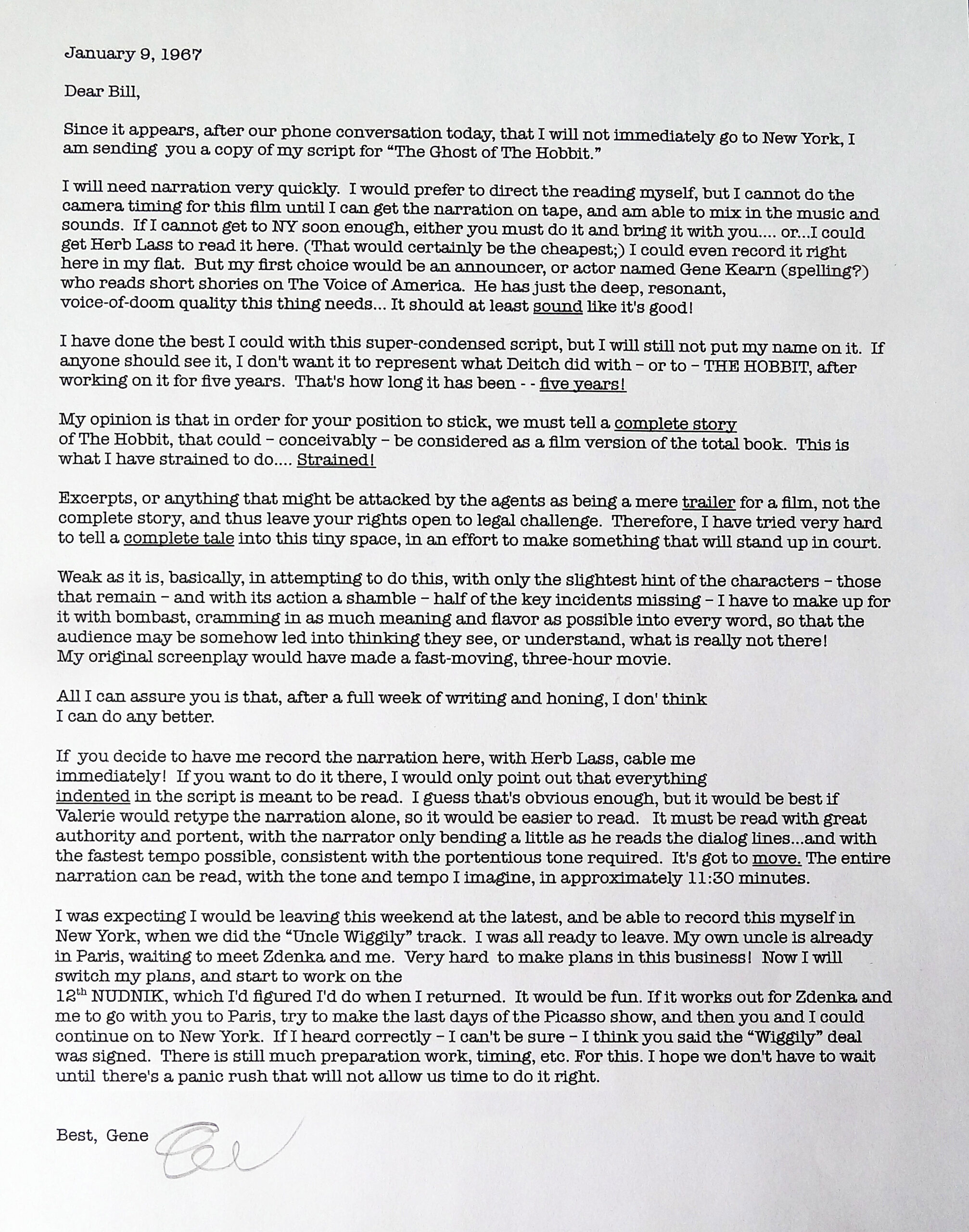
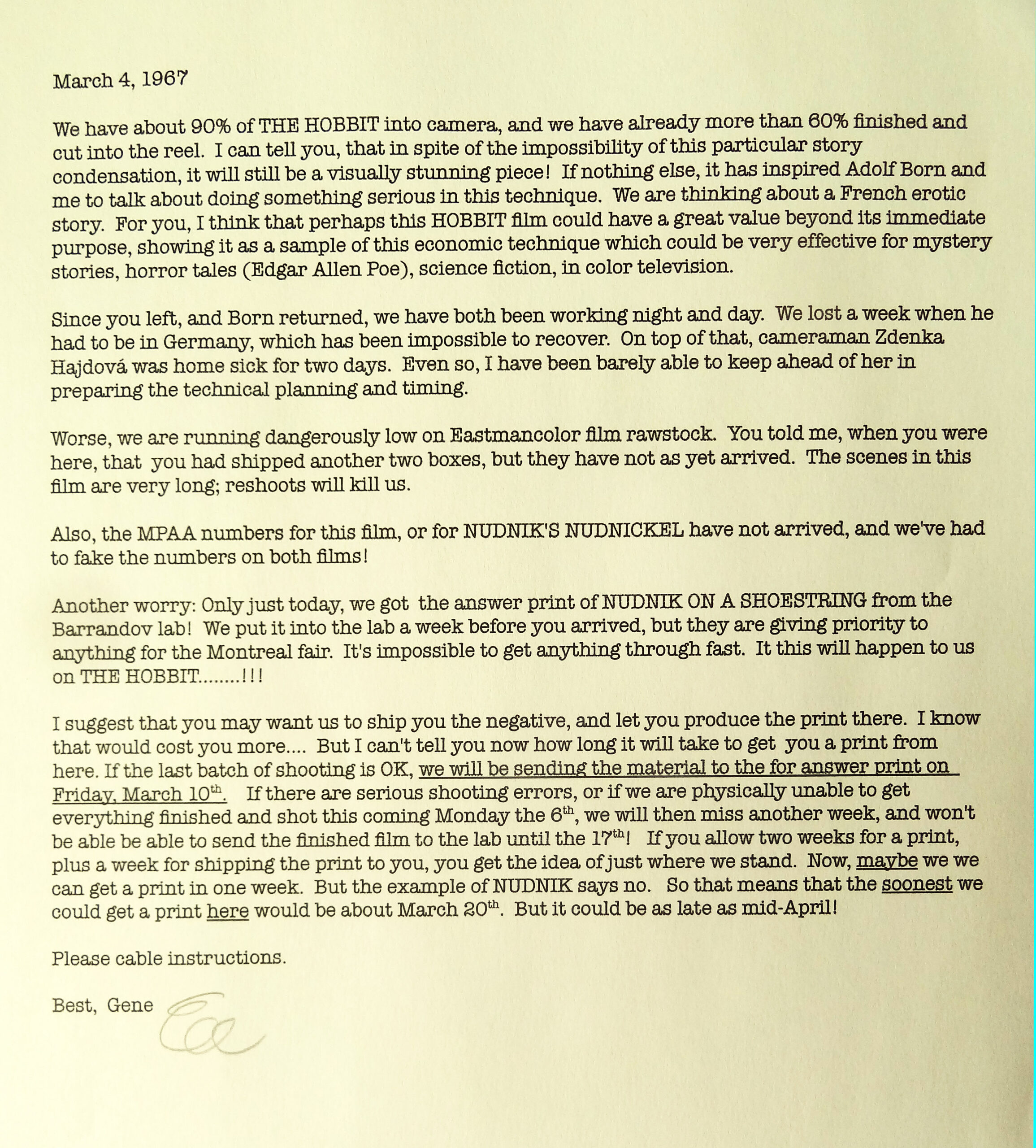
We actually managed to get it shot and out of the lab in time, (without bribes, but with Zdenka’s usual brand of irresistable-object techniques), and I arranged for my New York air ticket. I arrived with the rough answer print on June 29th. Snyder had already booked a small projection room in midtown Manhattan. After a quick test screening – and Snyder was duly impressed – I ran downstairs and stopped people on the sidewalk, asking them if they would like to see a preview of a new animated film, for only 10¢ admission. I handed each willing customer a dime, which they handed back. After the screening, the few, puzzled audience members were asked to sign a paper stating that on this day of June 31, 1966, they had paid admission to see the full-color animated film, “THE HOBBIT!”
March 4, 1967
We have about 90% of THE HOBBIT into camera, and we have already more than 60% finished and cut into the reel. I can tell you, that in spite of the impossibility of this particular story condensation, it will still be a visually stunning piece! If nothing else, it has inspired Adolf Born and me to talk about doing something serious in this technique. We are thinking about a French erotic story. For you, I think that perhaps this HOBBIT film could have a great value beyond its immediate purpose, showing it as a sample of this economic technique which could be very effective for mystery stories, horror tales (Edgar Allen Poe), science fiction, in color television.
Since you left, and Born returned, we have both been working night and day. We lost a week when he had to be in Germany, which has been impossible to recover. On top of that, cameraman Zdenka Hajdová was home sick for two days. Even so, I have been barely able to keep ahead of her in preparing the technical planning and timing.
Worse, we are running dangerously low on Eastmancolor film rawstock. You told me, when you were here, that you had shipped another two boxes, but they have not as yet arrived. The scenes in this film are very long; reshoots will kill us.
Also, the MPAA numbers for this film, or for NUDNIK’S NUDNICKEL have not arrived, and we’ve had to fake the numbers on both films!
Another worry: Only just today, we got the answer print of NUDNIK ON A SHOESTRING from the Barrandov lab! We put it into the lab a week before you arrived, but they are giving priority to anything for the Montreal fair. It’s impossible to get anything through fast. It this will happen to us on THE HOBBIT……..!!!
I suggest that you may want us to ship you the negative, and let you produce the print there. I know that would cost you more…. But I can’t tell you now how long it will take to get you a print from here. If the last batch of shooting is OK, we will be sending the material to the for answer print on Friday, March 10th. If there are serious shooting errors, or if we are physically unable to get everything finished and shot this coming Monday the 6th, we will then miss another week, and won’t be able be able to send the finished film to the lab until the 17th! If you allow two weeks for a print, plus a week for shipping the print to you, you get the idea of just where we stand. Now, maybe we we can get a print in one week. But the example of NUDNIK says no. So that means that the soonest we could get a print here would be about March 20th. But it could be as late as mid-April!
Please cable instructions.
Best, Gene
Thus Snyder’s film rights to the entire J.R.R. Tolkien library were legally extended, and he was immediately able to sell them back for nearly $100,000. (Remember, this was 1966). My share of this weazled boodle was – you guessed it – zip.
The final blow came some years later, when an animated feature version of THE HOBBIT appeared, starring the timid voice of Orson Bean. That film to my mind in no way approached the magnificence I had originally envisioned . I had obtained the greatest Czech artist, illustrator, painter, sculptor, and director of the most famous Czech puppet films of all time, Ji?í Trnka, to be the designer of my projected full-length version. Sadly, we never got beyond his model sketches. I will present them to you in the upcoming Credit 43.
My meager 12-minute film itself has just magically resurfaced thanks to Adam Snyder, who rediscovered the long forgotten single existing 35mm print, deep in the Rembrandt Films basement archives! It’s a genuine miracle, because I had assumed that this little film had totally vanished. So now you can see it right here, and judge it for yourself, in the light of what I have written about the time, place, and reasons of its origin. I repeat: it’s the very first film adaptation of THE HOBBIT, made 45 years ago in 1966!
There is much to remember about Bill Snyder. He did change my life for the better, and I do not forget that. And I also cannot forget the great fun we had together, and the marvelous creative burn as we both raced through the early days of our productions. He exuded confidence and optimism; he projected the image of a winner, and yet he lost; he never made his millions. He was a person no one could forget, and no one could cope with. We neither can cope with his inexplicable end.
Only Fate was able to defeat Bill Snyder, and I get no joy in making my points now. For Zdenka and me, there is much to think about, and much to remember. Zdenka still loves him.
And there is the wonder of Bill’s family, with whom I’ve nothing but wonderfully friendly and fruitful relations: His widow, Peggy, son Adam, daughters Trinka and Dana, Adam’s wife Patti, and their bright progeny, Lilli and Kasey. They are all among my favourite people. None of them are temperamental echoes of Bombastic Bill. Why this is, could only be explained in a very long story…
In retrospect, I can imagine how it all happened:
In his effort to lure me to his service, Snyder never referred to his animation facilitities as being in “Czechoslovakia.” Czech-o-slo-va-ki-a was a distant country with an extremely foreign, 6-syllable name, difficult for Americans to pronounce. But its capital city, “Prague,” had a 1-syllable name, spelled and pronounced exactly as the French and British spell and pronounce it, thus having a vaguely romantic and less sinister ring to it.
Snyder caught me at a vulnerable moment, after the loss of my greatest job, creative director of CBS-Terrytoons, and under the heavy economic burden of my own studio, and the tension and insecurity it was having on my home life.
Yet it all played out in a way that changed my life for the better!

 Subscribe On Youtube
 Follow on Bluesky
 Rate Us On IMDB
 Like Us On Facebook
 Follow Us On Twitter
 Season One Download (1080p HD)